
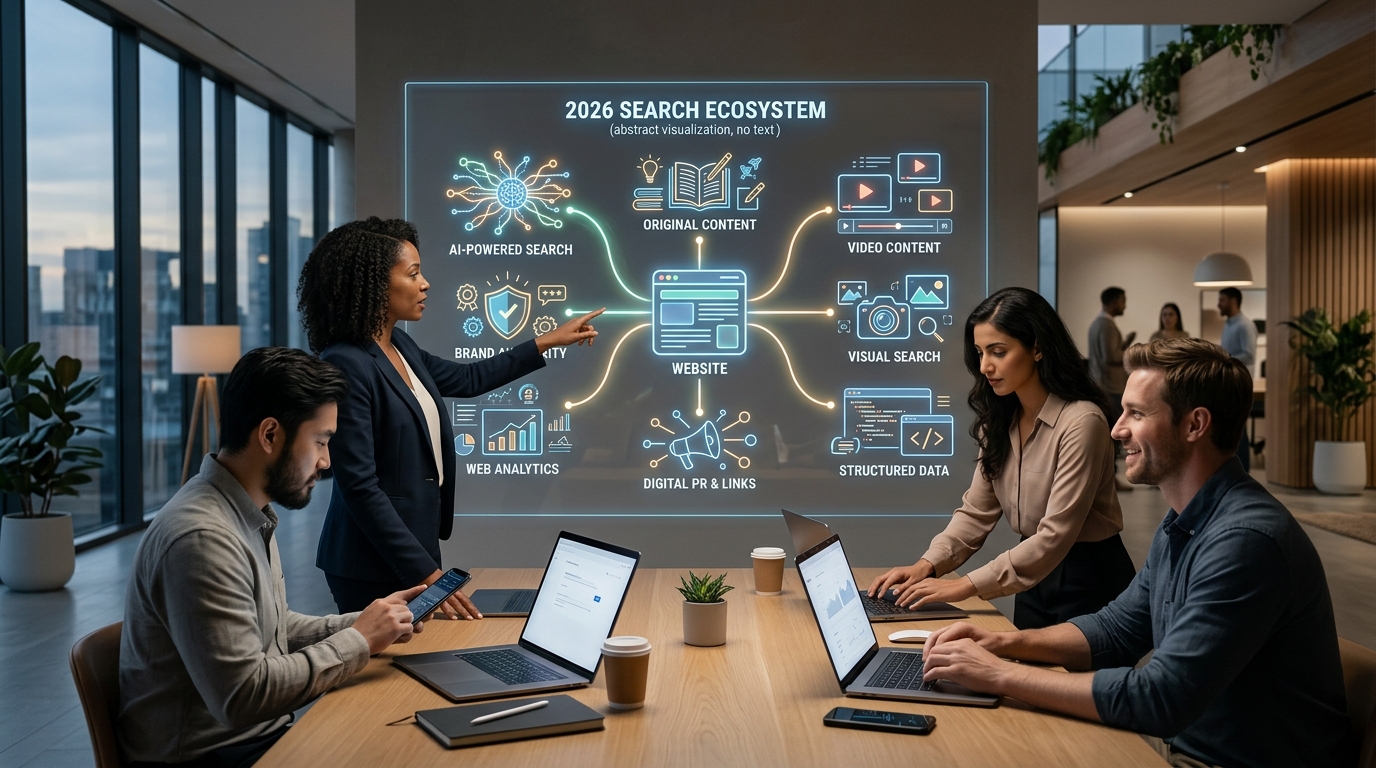
In 2026, search is no longer limited to a list of blue links. People discover brands through traditional search engines, AI-generated answers, visual search, voice assistants, social platforms, maps, and other increasingly intelligent digital experiences. In this changing environment, creativity has become an important part of building visibility, trust, and differentiation.
The fundamentals of SEO still matter, including technical performance, relevant content, structured data, internal linking, and authority. However, successful SEO now requires more than optimizing pages around keywords. Search systems increasingly need to understand meaning, context, entities, expertise, relationships, and user intent.
At Pimclick, we believe effective SEO combines technical expertise with creative thinking. A strong strategy should not simply help a website appear in search results; it should make the brand recognizable, useful, trustworthy, and memorable across the modern search ecosystem.
Understanding the Role of Creativity in Modern SEO

SEO has evolved from a largely keyword-focused discipline into a broader digital visibility strategy. Search engines and AI-powered search experiences are becoming better at understanding natural language, context, entities, and the relationship between different pieces of information.
This means that simply repeating a target keyword is no longer an effective way to create meaningful visibility. Instead, brands need content that answers real questions, demonstrates genuine expertise, and provides information that users cannot easily find everywhere else.
Creative SEO brings together:
- Search intent and audience research
- Original and experience-based content
- Strong brand storytelling
- Visual and interactive experiences
- Structured and semantically organized information
- Technical SEO and website performance
- AI-search and conversational-search optimization
- Consistent brand identity across digital channels
Creativity helps transform SEO from a purely technical exercise into a way of communicating why a brand deserves attention.
Creating Original Content for Humans and AI Search
Content remains one of the foundations of SEO, but the definition of valuable content has changed.
In 2026, brands face an environment where generic AI-generated articles can be produced at enormous scale. As a result, publishing more content is not necessarily the same as creating more value. Originality, first-hand experience, expertise, useful data, expert insights, case studies, and unique perspectives can provide stronger differentiation.
At Pimclick, we combine SEO strategy with creative content development to produce material that serves both users and modern search systems. Instead of creating content simply to include keywords, we focus on answering the questions behind those keywords.
For example, a strong article can combine:
- Original research and statistics
- Expert commentary
- Real business examples
- Step-by-step explanations
- Original photography and visual assets
- Infographics and diagrams
- Videos and demonstrations
- FAQs based on genuine customer questions
- Internal links connecting related topics
This approach creates a richer information resource while giving search engines and AI systems clearer context about the subject, the brand, and its expertise.
Building Content Around Topics, Entities, and Search Intent
Modern SEO is increasingly about relationships between topics rather than isolated keywords.
A brand that wants to establish authority around a subject should develop a connected ecosystem of useful content. Supporting articles, service pages, FAQs, case studies, guides, and original resources can work together to demonstrate depth.
For example, instead of creating multiple pages that repeat the same keyword, a business could build a comprehensive topic structure covering:
Core topic → related questions → supporting topics → practical examples → expert insights → services or products
This creates a clearer information architecture for both visitors and search technologies.
Creative thinking is particularly valuable here because brands can find distinctive angles that competitors have overlooked. The objective is not simply to cover a topic, but to provide a perspective and experience that makes the content genuinely useful.
Design-Driven SEO: Combining UX, Performance, and Brand Identity
Design is no longer separate from SEO.
A website needs to communicate its value quickly while making information easy to discover and interact with. A visually impressive website that is slow, confusing, inaccessible, or difficult to use can undermine the user experience.
Modern SEO therefore requires close collaboration between designers, developers, content specialists, and SEO professionals.
Creative SEO design can include:
- Clear and intuitive navigation
- Mobile-first layouts
- Fast-loading pages
- Accessible interfaces
- Strong visual hierarchy
- Interactive elements where they genuinely improve usability
- Optimized images and video
- Clear calls to action
- Consistent brand identity
- Logical internal linking
Core Web Vitals and technical performance remain important, but optimization should not happen at the expense of the user experience. The goal is to create a website that is both technically efficient and enjoyable to use.
Optimizing for AI-Powered Search Experiences
One of the most important developments in SEO is the growth of AI-powered search.
Search experiences can now summarize information, answer conversational questions, compare options, and connect information from multiple sources. This creates a new challenge for brands: visibility is no longer only about earning a traditional organic ranking.
Brands should make their information easy to understand, verify, and connect with.
This means paying attention to:
- Clear factual statements
- Well-structured headings
- Concise answers to common questions
- Consistent business information
- Author and organization context
- Relevant structured data
- Strong internal linking
- Credible external references
- Original research and evidence
- Clearly defined products, services, people, and organizations
The objective is not to manipulate AI systems into mentioning a brand. Instead, it is to create a trustworthy digital presence that search technologies can understand and users can verify.
Creative Meta Elements and Search Result Optimization
Search-result optimization remains an important part of SEO, even as search experiences evolve.
Title tags and meta descriptions should communicate the value of a page clearly and naturally. They should give users a reason to explore the result rather than simply repeating a list of keywords.
Creative optimization can also involve:
- Descriptive page titles
- Compelling meta descriptions
- Clear URL structures
- Appropriate heading hierarchies
- Relevant structured data
- Breadcrumbs
- Product information where applicable
- Organization and local business information
- FAQ content when genuinely useful
Structured data does not guarantee enhanced search features, but accurate machine-readable information can help search engines better understand the content and entities represented on a page.
Creative Link Building and Digital PR
Authority is still an important part of SEO, but successful link building increasingly depends on creating something worth referencing.
Instead of focusing on acquiring large numbers of low-value links, creative campaigns can produce assets that journalists, publications, researchers, bloggers, and industry websites genuinely want to cite.
Examples include:
- Original industry research
- Surveys and reports
- Proprietary statistics
- Interactive tools
- Expert interviews
- Data visualizations
- Digital PR campaigns
- Industry guides
- Original case studies
- Useful calculators and resources
This connects SEO with digital PR and content marketing. When a brand creates something genuinely useful or newsworthy, relevant references and mentions can develop naturally.
Expanding Beyond Text: Visual, Video, Voice, and Interactive Search
Search behavior is becoming increasingly multimodal.
People can search using text, images, voice, video, and conversational interfaces. This means brands should consider how their content works across different formats rather than treating written web pages as the only SEO asset.
Depending on the audience, a strategy could include:
- Short-form and long-form video
- Original photography
- Infographics
- Interactive tools
- Podcasts
- Webinars
- Demonstrations
- Downloadable resources
- Visual explainers
- Conversational FAQs
For example, a product page can combine detailed written information with original photography, demonstration video, specifications, FAQs, and structured product information. This gives users multiple ways to understand the same subject while strengthening the overall digital presence.
Using AI as a Creative SEO Tool — Not a Replacement for Expertise
Artificial intelligence has become an important part of modern SEO workflows, but its greatest value comes from supporting human expertise rather than replacing it.
AI tools can help SEO teams with:
- Search-intent analysis
- Content research
- Topic clustering
- Content briefs
- Data analysis
- Technical audits
- Schema generation
- Content ideation
- Translation workflows
- Performance analysis
- Content gap discovery
However, human review remains essential. AI-generated information can be incomplete, inaccurate, repetitive, or disconnected from a brand's actual experience.
The strongest approach is often AI-assisted, expert-led SEO: technology accelerates research and production while people provide experience, judgment, originality, accuracy, and brand perspective.
Creativity as a Competitive Advantage in 2026
As AI makes it easier to produce generic content, creativity can become an even more important differentiator.
Two companies may publish articles about exactly the same topic. One may provide a generic explanation that looks similar to thousands of other pages. The other may offer original research, expert experience, distinctive visuals, useful examples, and a recognizable point of view.
Both may target the same search intent, but the second creates a stronger reason for users to remember and trust the brand.
This is where SEO, content marketing, UX, branding, data, and AI technology increasingly overlap.
Conclusion
Creativity is becoming an increasingly important part of modern SEO.
Technical SEO provides the foundation. Content provides information. Structured data helps machines understand that information. AI tools can accelerate research and production. But creativity brings these elements together into experiences that are distinctive, useful, and meaningful.
In 2026, successful SEO is not simply about asking, "How can we rank for this keyword?"
It is about asking:
"How can we create the most useful, credible, distinctive, and memorable experience around this topic?"
At Pimclick, we combine SEO expertise, creative content, UX, technology, and digital strategy to help brands build stronger visibility across traditional search and the expanding AI-powered search ecosystem.
In an increasingly automated digital world, originality, expertise, and meaningful user experiences can become some of a brand's most valuable SEO assets.