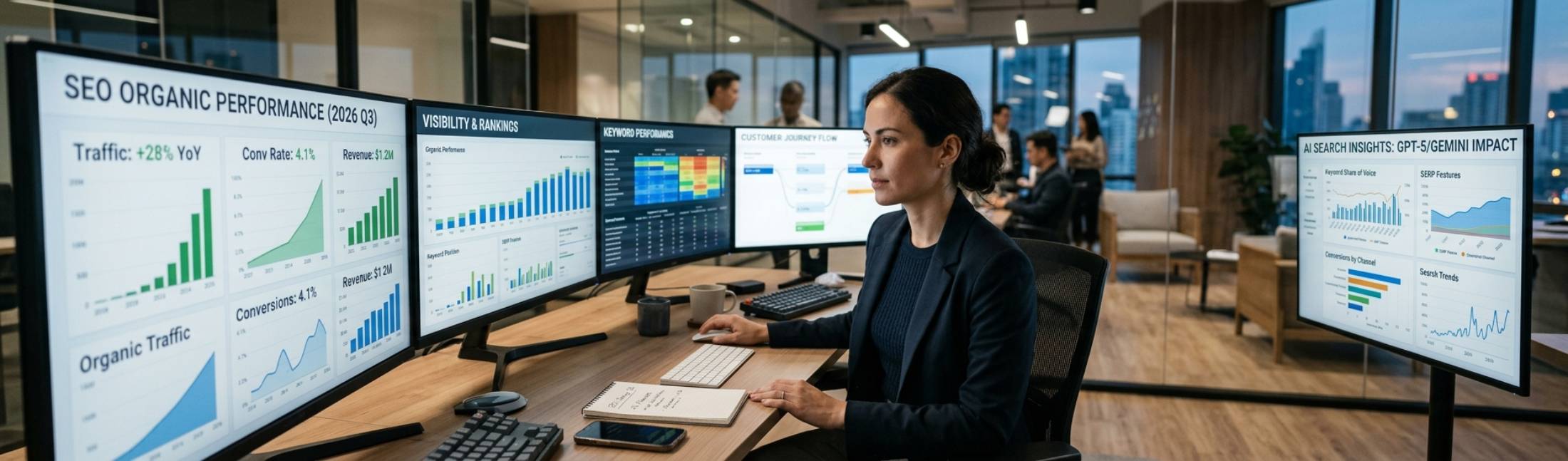
SEO is often judged by rankings alone, but in 2026, businesses need to look far beyond positions on traditional search engine results pages. Search has evolved into a broader ecosystem that includes AI-powered search experiences, answer engines, featured results, maps, videos, social platforms, and other discovery channels.
True SEO success is measured by its impact on business goals—qualified traffic, leads, conversions, revenue, customer retention, brand visibility, and long-term growth.
By shifting the focus from vanity metrics to actionable business insights, marketers can demonstrate the real value of SEO campaigns, understand how organic visibility influences the customer journey, and make better strategic decisions.
Understanding the Difference Between Rankings and Business Impact
High rankings remain valuable, but they are only one part of modern SEO performance. A page can rank well and generate substantial traffic without producing meaningful business results.
In 2026, businesses should evaluate SEO through metrics such as:
- Traffic quality: Are visitors genuinely interested in your products, services, or expertise?
- Search visibility: Is your brand appearing across traditional results, AI-generated answers, local search, video, and other relevant discovery surfaces?
- Conversions: Are organic visitors becoming leads, customers, subscribers, or qualified prospects?
- Revenue contribution: How much revenue can be connected to organic search and organic discovery?
- Customer lifetime value: Do SEO-driven customers return, renew, or make additional purchases?
- Brand demand: Is organic visibility contributing to branded searches, direct traffic, and stronger market recognition?
Focusing exclusively on rankings can be misleading if those rankings do not generate qualified users or contribute to business growth.
Key Metrics to Measure SEO Impact in 2026

To understand the real business impact of SEO, track metrics that connect organic performance with organizational goals.
Organic Traffic and Engagement
Traffic volume alone is no longer enough. Evaluate the quality and relevance of organic visitors by monitoring metrics such as engaged sessions, engagement rate, pages viewed, returning users, and interactions with important content.
The objective is not simply to attract more visitors, but to attract the right visitors.
Search Visibility Across Multiple Surfaces
Modern search extends beyond the traditional blue links. Monitor how your brand and content appear across:
- Traditional organic search results
- AI-generated search experiences
- Featured snippets and other search features
- Local search and map results
- Video search
- Image search
- News and discovery surfaces
- Branded and non-branded searches
This broader view provides a more accurate picture of your overall search visibility.
Lead Generation and Conversions
Track actions that have direct business value, including:
- Contact form submissions
- Appointment or consultation requests
- Phone calls
- Newsletter registrations
- Downloads
- Product purchases
- Account registrations
- Service inquiries
Connect these conversions to their original organic landing pages and search journeys whenever possible.
Revenue Attribution
SEO should ultimately be connected to financial outcomes.
Use analytics and CRM data to determine how organic search contributes to:
- E-commerce revenue
- Qualified sales opportunities
- Service inquiries
- New customers
- Recurring revenue
- Customer lifetime value
Revenue attribution helps demonstrate that SEO is not simply generating traffic—it is contributing to business performance.
Cost Efficiency and Savings
Organic search can reduce dependence on paid acquisition.
Compare the value generated through organic traffic with the estimated cost of acquiring similar traffic through paid advertising. This can help businesses understand SEO's role as a long-term acquisition and cost-efficiency channel.
Customer Retention and Lifetime Value
SEO does not stop at the first conversion.
Analyze whether customers acquired through organic search:
- Return to the website
- Make repeat purchases
- Renew subscriptions
- Book additional services
- Engage with educational content
- Become long-term customers
This provides a clearer picture of the long-term value of SEO-driven customers.
Using Analytics to Connect SEO With Business Goals
Data-driven SEO requires more than installing an analytics platform. Businesses need an integrated measurement framework that connects search visibility with customer and revenue data.
Google Analytics 4
GA4 can be used to measure traffic sources, engagement, conversions, user journeys, and important events.
SEO teams should focus on business-critical events rather than relying primarily on pageviews or sessions.
Google Search Console
Search Console provides valuable information about organic queries, clicks, impressions, click-through rates, indexing, and search performance.
In 2026, these insights should be combined with broader visibility and conversion data rather than treated as the complete picture of SEO success.
CRM Integration
Connecting organic acquisition data with a CRM makes it possible to follow the customer journey from search → website → lead → opportunity → customer.
This is particularly important for B2B companies and businesses with longer sales cycles.
Attribution Models
Customers often interact with multiple channels before converting.
Use attribution analysis to understand how organic search contributes alongside:
- Paid advertising
- Email marketing
- Social media
- Direct traffic
- Referral traffic
- Brand interactions
SEO may influence a conversion without being the final touchpoint.
Custom Dashboards
Create dashboards that connect SEO performance directly to business KPIs such as:
- Qualified organic traffic
- Leads
- Conversion rate
- Revenue
- Customer acquisition cost
- Customer lifetime value
- Returning customers
- Branded search demand
This transforms SEO reporting from a ranking report into a business performance report.
Measuring SEO in the Age of AI-Powered Search
One of the biggest changes in 2026 is the growing importance of AI-powered search and answer experiences.
Users may discover information without clicking a traditional search result. Search engines and AI systems can summarize information, compare businesses, answer questions, and guide users toward specific products or services.
As a result, businesses should expand their definition of SEO visibility.
"What position does this keyword have?"
Instead, ask:
"How visible is our brand throughout the search journey, and is that visibility generating business value?"
This means monitoring brand mentions, search demand, qualified visits, referral patterns, conversions, and visibility across relevant AI and search experiences where measurable data is available.
The goal is not simply to optimize for rankings, but to build trusted, useful, authoritative digital assets that can be discovered and referenced across modern search environments.
Evaluating the Long-Term Value of SEO
Unlike many paid campaigns, SEO can continue generating value after the initial investment.
Content Longevity
High-quality content can attract qualified visitors for months or years when it remains accurate, useful, and aligned with search intent.
Brand Authority
Consistent organic visibility can strengthen brand recognition and perceived expertise, particularly when content demonstrates genuine knowledge and satisfies users' needs.
Compounding Returns
A strong SEO foundation can create cumulative benefits as content earns links, attracts mentions, builds authority, and generates additional discovery opportunities.
Lower Dependence on Paid Acquisition
A mature organic search strategy can diversify acquisition channels and reduce dependence on continuously increasing advertising spend.
However, SEO is not completely passive. Content, technical optimization, internal linking, structured data, digital PR, and user experience often require ongoing investment to maintain performance.
Aligning SEO With Business Strategy
SEO delivers the greatest value when it is integrated into the wider business strategy.
- Prioritize pages and topics with strong commercial potential.
- Target search intent rather than focusing only on keyword volume.
- Identify keywords and topics connected to revenue opportunities.
- Optimize content for users as well as modern search and AI discovery systems.
- Strengthen internal linking between informational and commercial content.
- Collaborate with sales, product, customer service, and marketing teams.
- Use CRM data to identify which organic leads generate the greatest value.
- Continuously update important content as search behavior and customer expectations evolve.
- Measure SEO against business KPIs rather than isolated ranking improvements.
This turns SEO into a strategic growth function rather than an isolated marketing activity.
Building a 2026 SEO Measurement Framework
A practical SEO measurement framework should connect four levels of performance:
Level 1: Visibility
Measure:
- Rankings
- Impressions
- Clicks
- Search visibility
- Brand mentions
- AI and search feature visibility
Level 2: Engagement
Measure:
- Engaged sessions
- Landing-page performance
- Returning users
- Content interactions
- User journeys
Level 3: Conversions
Measure:
- Leads
- Sales
- Bookings
- Sign-ups
- Calls
- Qualified opportunities
Level 4: Business Impact
Measure:
- Revenue
- Customer acquisition cost
- Customer lifetime value
- Retention
- Repeat purchases
- Return on SEO investment
This framework makes it easier to identify where SEO is succeeding and where improvements are needed.
For example, strong visibility but weak conversions may indicate a landing-page or intent problem. Strong traffic but low revenue may indicate that the strategy is attracting users who are not commercially relevant. Strong conversions but low visibility may indicate an opportunity to scale successful content.
Conclusion
In 2026, SEO success cannot be measured by rankings alone. Search behavior is becoming more complex, and users are discovering businesses through traditional results, AI-powered search experiences, local results, multimedia content, and multiple digital touchpoints.
The most effective SEO strategies therefore connect visibility to engagement, conversions, revenue, and long-term customer value.
By combining search data with analytics, CRM information, attribution models, and business KPIs, organizations can understand the true contribution of organic search.
The goal is no longer simply to rank higher.
The goal is to be discovered by the right audience, earn trust, generate meaningful actions, and create measurable business growth.