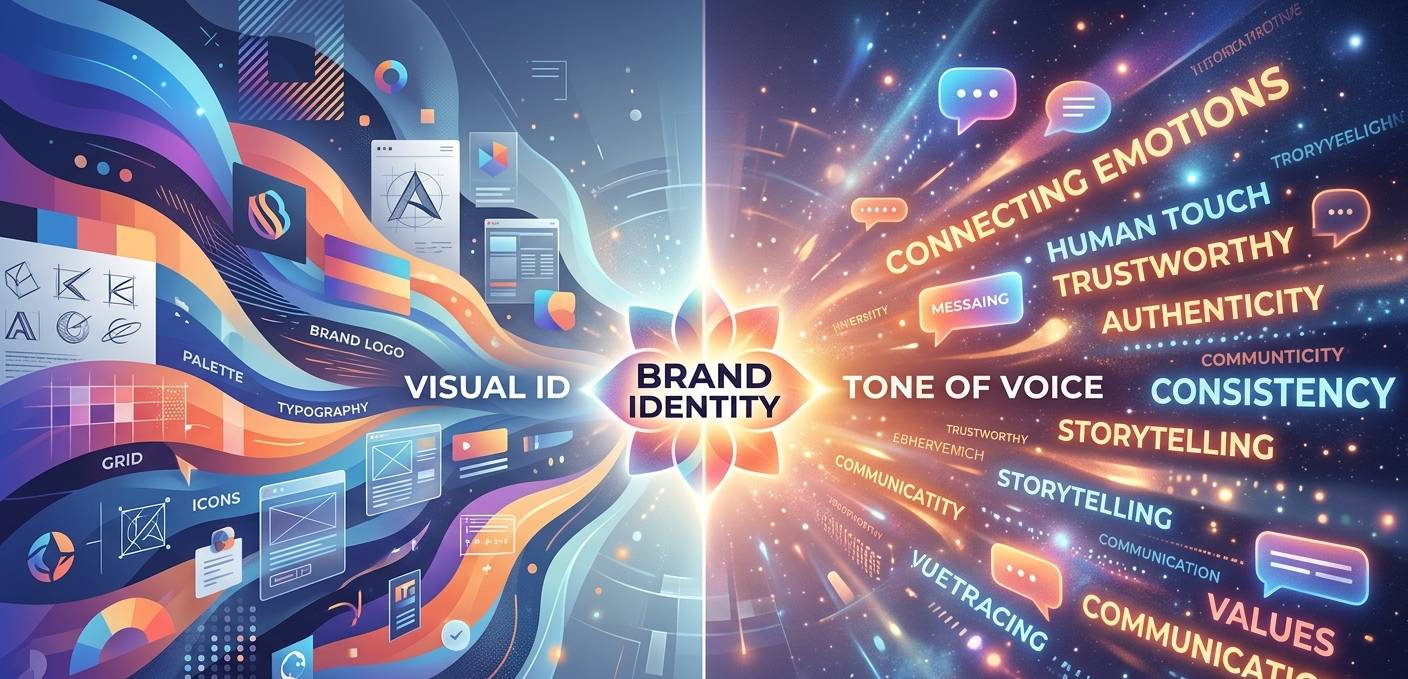
In today’s digital-first world, a brand is far more than its logo, typography, or color palette. It is a living identity—one that speaks, behaves, and evolves alongside its audience.
Yet many companies invest heavily in refreshing their visual identity while neglecting something equally important: their tone of voice.
Your brand’s tone is the emotional and linguistic expression of who you are. It is how your audience feels your personality through words.
When visuals evolve but tone remains outdated—or vice versa—the result is a fragmented experience. Your brand may look modern, but it can still sound disconnected.
In 2026, true brand relevance means evolving both visual identity and verbal identity together.
The Symbiosis of Sight and Voice
Visual identity shapes what people see.
Tone of voice shapes what they hear.
Together, they define how your brand feels.
Think of them as two parts of one conversation:
- Design creates the first impression
- Tone builds emotional connection
- Together, they create trust and recognition
When these elements are aligned, your audience experiences a cohesive and memorable brand.
When they are not, the disconnect becomes immediately noticeable.
Examples of mismatch:
- A sleek, minimalist website paired with overly formal or outdated copy
- A bold and vibrant rebrand supported by generic corporate messaging
- Luxury visuals combined with casual, inconsistent language
When visual identity and tone evolve in harmony, your brand feels intentional, credible, and emotionally relevant.
Why Brands Must Continuously Evolve
The digital landscape moves faster than ever. Consumer expectations, communication habits, and cultural signals shift constantly.
What felt innovative just a few years ago may now feel outdated.
Brands evolve for several important reasons:
Cultural change
Language, values, and aesthetics evolve rapidly. Brands must adapt to remain relatable and culturally aware.
Audience transformation
As audiences grow and diversify, communication styles must become more flexible, inclusive, and personalized.
Platform expansion
Your brand now exists across websites, social media, apps, AI assistants, voice interfaces, and immersive digital spaces. Tone and visuals must adapt seamlessly across every touchpoint.
Business maturity
As a company evolves, its identity should reflect its growth, confidence, and long-term vision.
Evolution does not mean abandoning your foundation.
It means refining how your brand expresses itself.
Visual Identity: The Emotional First Impression
Visual updates are often the first visible signs of brand evolution.
A refreshed logo, updated typography, refined imagery, or modernized color palette immediately signals transformation.
But visual identity does more than improve appearance—it shapes emotional perception.
Color psychology
Colors influence how audiences feel:
- Warm tones create approachability and energy
- Cool tones communicate sophistication and trust
- Neutral palettes suggest elegance and clarity
Typography personality
Fonts shape subconscious impressions:
- Serif fonts often feel timeless and authoritative
- Sans-serif fonts feel modern and accessible
- Custom typography adds uniqueness and distinction
Visual storytelling
Photography, illustration, and motion design communicate values instantly.
Authentic imagery builds trust.
Bold creative visuals inspire curiosity.
Minimalist design communicates confidence.
Strong visuals prepare your audience emotionally for the voice that follows.
Tone of Voice: The Soul of Your Brand
If visual identity is your brand’s face, tone of voice is its personality.
It communicates values, emotion, and intent through language.
In 2026, audiences expect brands to sound more human, more transparent, and more emotionally intelligent.
Evolving your tone may include:
Becoming more conversational
Brands are moving away from rigid corporate language toward warmer, more natural communication.
Simplifying for clarity
Clear, accessible language builds trust and inclusivity.
Adding empathy and emotional intelligence
Audiences respond to brands that understand their needs and communicate with authenticity.
Becoming more adaptive
Tone may shift slightly depending on context—social media, customer support, product pages, and AI chat interactions all require different expressions of the same personality.
The most trusted global brands succeed because their tone is unmistakably recognizable.
Apple Inc. communicates with clarity and confidence.
Nike, Inc. speaks with inspiration and momentum.
Airbnb, Inc. uses warmth and belonging.
Their words and visuals always feel aligned.
The Risk of Evolving Only One Side

One of the most common branding mistakes is updating visuals without updating tone.
Imagine a company that launches a modern, vibrant redesign but continues using stiff, outdated corporate messaging.
The result is friction.
Audiences may not consciously identify the issue, but they feel the inconsistency.
This creates:
Confusion
Users struggle to understand what your brand truly represents.
Distrust
Misalignment feels inauthentic or rushed.
Fragmentation
Brand identity becomes inconsistent across channels.
To build credibility, visual and verbal evolution must happen together.
Brands That Evolve Successfully
Spotify Technology S.A.
Spotify modernized its visual identity with bold gradients, motion design, and dynamic layouts while evolving its tone to become more conversational, inclusive, and culturally responsive.
The result is a brand that feels alive and deeply connected to its audience.
Intuit Mailchimp
Mailchimp’s visual redesign embraced playful professionalism, perfectly matched by its friendly, witty, and empowering tone.
Its evolution demonstrates how maturity can happen without losing personality.
The Coca-Cola Company
Coca-Cola continuously refreshes its visuals and messaging to reflect modern values—from nostalgia to global unity to sustainability—while preserving its emotional core.
Its consistency lies in emotional continuity, not visual sameness.
How to Evolve Tone and Visuals Together
Successful brand evolution requires strategic alignment.
Audit your current identity
Identify gaps between how your brand looks and how it sounds.
Define your future positioning
What emotions should your audience feel in 2026?
Build unified brand guidelines
Create integrated systems for design and tone that support one another.
Test before launching
Use audience feedback, A/B testing, and user research to measure resonance.
Roll out consistently
Introduce updates gradually across all channels to avoid confusion.
The goal is evolution—not reinvention.
Emotional Consistency Builds Long-Term Trust
When visuals and tone evolve together, your audience feels something powerful:
stability within change.
They recognize your brand, even as it grows.
This creates:
- Trust — change feels intentional
- Loyalty — your audience grows with you
- Authenticity — every update feels meaningful
- Relevance — your brand remains connected to the present
The strongest brands are not static.
They are living systems that adapt while staying emotionally recognizable.
Conclusion: Evolution Is the New Consistency
In 2026, consistency no longer means staying the same.
It means evolving authentically.
Your visual identity and tone of voice are not separate branding tools—they are two halves of one brand experience.
When they evolve together, your brand remains relevant, trusted, and emotionally compelling.
Because people do not simply follow brands that look good.
They follow brands that feel right.